|
|
CURRENT RESEARCH INTERESTS |
|
|
|
Discovering Novel Structures, Reaction Mechanisms and Chemical Phenomena Using Computational Quantum Chemical Methods
Geconcerteerde Onderzoeksactie (GOA) Project: Quantum Rules for Nanoclusters by Minh T. Nguyen, Arnout Ceulemans, Liviu Chibotaru and Marc Hendrickx
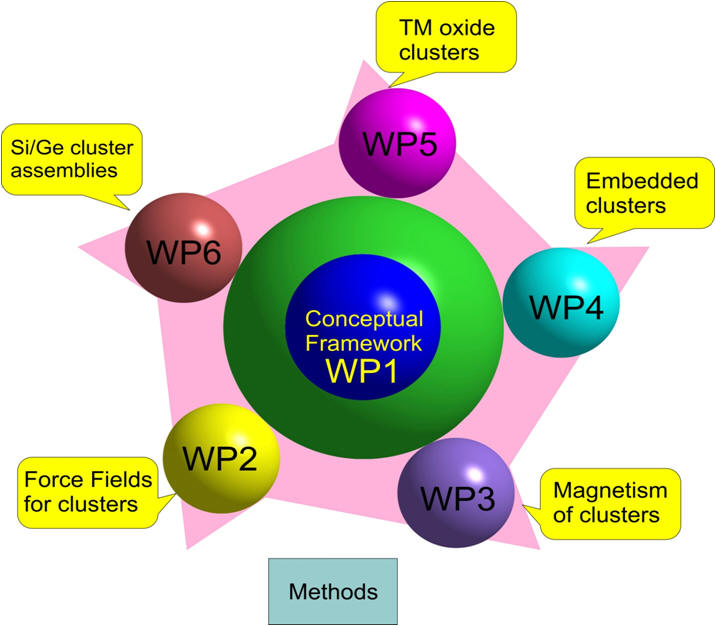
Chemistry consistently thrives on concepts, models and rules. The concept of electron-pair developed by Lewis a century ago (1916) remains for example a pillar of modern chemistry. The Woodward-Hoffmann rules first introduced in 1965, that changed the way of thinking of chemists, continue to be an efficient tool for rationalizing and predicting organic reactions. Many of these were however formulated empirically and therefore need to be continuously tested by the wealth of new findings. The pivotal concept of aromaticity is thus facing real challenges when dealing with non-planar compounds, as the classical Hückel rule is valid only for planar systems. The fast symbiotic interaction between modern experiment and theory helps to regularly scrutinize them and lead to further improvements, in particular for understanding the properties of numerous emerging classes of compounds. The theory of chemical bonding, supported nowadays by high accuracy electronic structure computations, provides us with a unifying approach in the discovery of concepts and rules that govern the universe of chemical exploration. Nanochemistry emerged as a new branch of chemistry, simultaneously expanding into many new areas, and playing a significant role in fields that were domains of engineering or life science. Nanochemistry brings together multiple disciplines using chemical theories and experiments to investigate materials at the nanoscale. Of the latter, the elemental nanoclusters continue to attract much interest due not only to their intriguing physicochemical features but also to a manifold of potential industrial applications. What are clusters? A “metal cluster” was first defined as “a finite group of metal atoms that are held together mainly or at least to a significant extent, by bonds directly between the metal atoms, even though some non-metal atoms may also be intimately associated with the cluster” (F. A. Cotton, 1964). The concept of cluster has also been used for characterizing molecular complexes as they are formed in plasmas by frequently unknown clusterification processes. Clusters MN are thus aggregates of a finite number N of atoms or molecules M, bridging the gap between the isolated atom/molecule and the macroscopic solid state of matter. Due to the way they are generated, clusters can be regarded as gas phase compounds. Small clusters go from smooth growth to increasingly strong variations in properties. This is a consequence of the quantum size regime, in which each additional atom makes a difference, with each size being a unique entity. The cluster growth mechanism allows the transition from the atoms to molecules and to bulk materials to be understood. Cluster science is thus interdisciplinary and relevant to many fields including materials science, environment, biology, medicine,… and widely spread especially in physics and chemistry. Therefore cluster science is considered as a bridge across disciplines. The stabilities and properties of clusters depend on both the nature of constituent elements and sizes. The well-known buckyball C60 is a cluster having high thermodynamic stability and high symmetry. Additionally, combination of various types of elements results in a huge number of mixed clusters. Binary clusters composed of two elements are of particular interest due to the high propensity for control, tuning properties and wide applications. Depending on the atoms ratio in a binary cluster the elements can be classified as host (having large percentage) or dopant (having small percentage). Certain clusters having a “magic number” behaviour which exhibit high thermodynamic stability and are referred to as “superatoms”, can be used as potential building blocks for cluster-assembled materials. The latter are of great current interest as they take advantage of novel properties of clusters and make them accessible in bulk materials. Cluster-based nanostructures have great chance to become pivotal for a new generation of catalysts, semiconducting materials and devices with tailored properties. For such purpose, we should be able to predict their characteristics using appropriate theoretical tools. While concepts and rules for rationalising and predicting structures, properties and reactivities of different classes of organic and inorganic compounds have long reached maturity, relatively less has been formulated for the clusters. Stability of clusters generated from experiment is currently interpreted by the ‘magic numbers’ derived from different electron shell models and compact shapes, whereas bottlenecks remain in the prediction of their geometric and electronic structures. In this context, the aim of this research project is to establish a set of general rules for nanoclusters using theoretical analyses and quantum chemical computations. This project contains three components including a conceptual framework, a method development, and the systems. The conceptual framework concerns a derivation of quantum rules governing the chemical bonding in nanoclusters, their growth pathterns and the design of structures with specific properties In methodology, development of new methods is carried out. These involve, among others, the partition and projection of wavefunctions and total densities in terms of bonds. Force field methods (FF) can bridge the gap between the accurately determined small clusters and larger nanomaterials. Implementation of appropriate FF and molecular dynamics (MD) simulations is carried out to describe clusters with increasing nuclearity and complexity. Development of new quantum chemical methods for treatment of optical and magnetic phenomena in different types of clusters forms. A number of specific clusters including a wide range of transition metals, the boron, the silicon- and germanium-based clusters. Our theoretical work will be in close collaboration, some in concert, with experimental groups both inside and outside KU Leuven
|
|
|
|
|
|
Copyright ©2003 Quantum Chemistry - All rights reserved. Designed by Phung Quan. Last Updated: 06/19/2013 | |