|
|
CURRENT RESEARCH INTERESTS |
|
|
|
Discovering Novel Structures, Reaction Mechanisms and Chemical Phenomena Using Computational Quantum Chemical Methods
Formation and Reactions of Formamide and Related Prebiotic Compounds
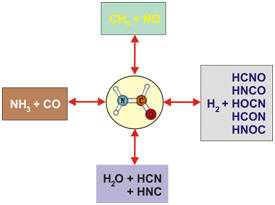
Formamide (NH2CHO, FM) has recently been considered as an active key precursor in prebiotic Earth chemistry leading to more complex biomolecules. It also has been tentatively identified in interstellar ices, the long period comet C/1995 O1 Hale-Bopp, and in the protostellar source NGC 7538 IRS9. These findings have fueled interest in FM’s role in the formation of more complex molecules such as amino acids on interstellar icy grains. FM is the simplest stable organic species having the four most common (CHNO) elements. It is the simplest member of the amide functional group, which contains the prototypical NH-C=O peptide linkage. This linkage is reactive at both amino and carbonyl sites and is expected to constitute a key building block for formation of nucleic acids. FM is thus a likely precursor for prebiotic nucleobases because of its relative stability, low volatility compared to water, and versatile reactivity. Previous studies showed that the major products of FM decomposition are CO, CO2, NH3, H2, H2O, H2, HCN and formic acid,… depending on initial conditions. In other words, FM can be formed from different mixtures of simple organic molecules found in prebiotic environments (cf. Figure). However the FM formation and its chemistry have not fully been understood yet. In this package, we carry out a comprehensive quantum chemical study on the thermal and photochemical formations and transformations of FM, not only in the lowest-lying singlet manifold, but also in some lower-lying excited states. To understand the interstellar icy conditions, we pay a particular attention on the role of water and water oligomers, as well as the role of the solid surfaces in FM transformations. Current ab initio quantum chemical calculations are expected to provide thermochemical parameters of small size organic compounds with high accuracy, up to ±1.0 kcal/mol on heats of formation of equilibrium structures and ±2.0 kcal/mol on activation energies. Careful constructions of the relevant and reliable potential energy surfaces allow us to identify new reaction intermediates and pathways, and thereby novel molecular mechanisms. The kinetic parameters of various reaction channels that are needed for global kinetic simulations, can subsequently be evaluated using calculated geometric, vibrational and energetic results. Calculated rotational and vibrational spectra could also be helpful in the subsequent experimental identification of new or unknown species.
|
|
|
|
|
|
Copyright ©2003 Quantum Chemistry - All rights reserved. Designed by Phung Quan. Last Updated: 06/19/2013 | |